
Carnation (Dianthus caryophyllus)
Carnations are long-lasting, ruffled flowers (Dianthus caryophyllus) available in almost every colour, loved for their spicy clove scent and exceptional vase life.
Overview
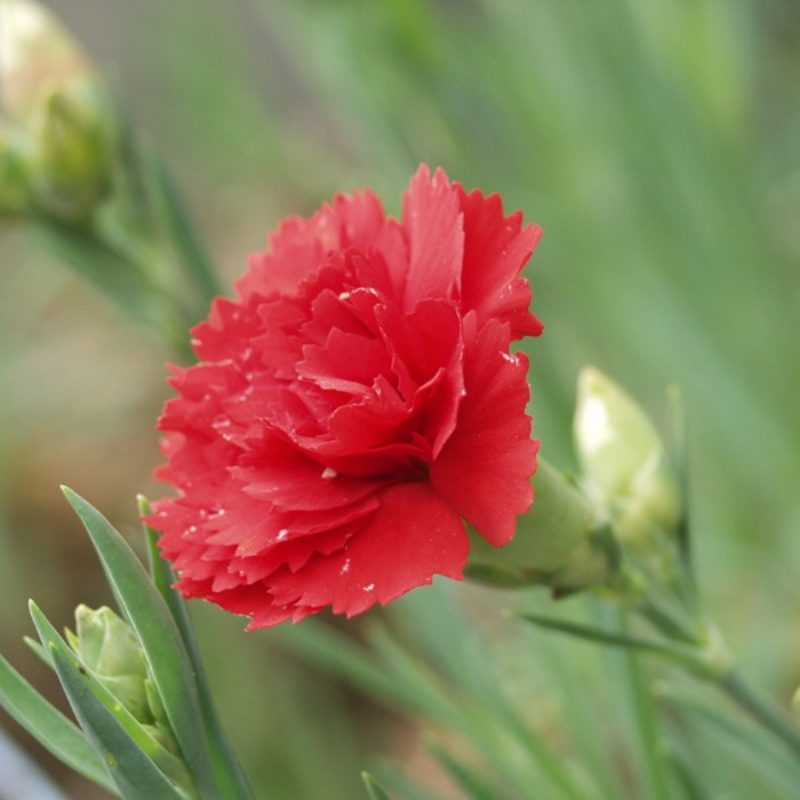
The carnation (Dianthus caryophyllus, family Caryophyllaceae) is a herbaceous perennial native to the Mediterranean region. It has been cultivated for more than 2,000 years and is today one of the most widely grown cut flowers in the world, valued for its ruffled petals, sweet clove-like fragrance and outstanding durability.
Appearance
Carnations have slender, blue-green, grass-like leaves and jointed stems. The flowers are densely packed with frilled or serrated petals and come in solid colours, bi-colours and picotee (edged) patterns.
Types
- Standard carnations – one large bloom (5–8 cm) per stem.
- Spray carnations (mini carnations) – several smaller blooms per stem, ideal as filler.
- Dwarf / border carnations – compact garden varieties.
Colour Meanings
- Red – deep love and admiration.
- Pink – a mother's love; the traditional Mother's Day flower.
- White – pure love and good luck.
- Yellow – cheerfulness (historically also disappointment).
- Purple – capriciousness and individuality.
Use in Bouquets
Carnations work as both a secondary flower and a mass flower. Their ruffled texture adds volume, and they are frequently used in boutonnières, corsages, mixed bouquets, funeral sprays and floral foam designs because they tolerate handling and out-of-water time better than most flowers.
Care & Vase Life
- Recut stems just above a node (the swollen joint) so they can drink.
- Strip any leaves below the water line.
- Change water every 2–3 days and add flower food.
- Keep away from ripening fruit – carnations are sensitive to ethylene gas.
- Typical vase life: 14–21 days, one of the longest of any cut flower.
Fun Facts
- The genus name Dianthus comes from Greek and is often translated as “flower of the gods”.
- Green carnations are created by dyeing white carnations and are popular on St Patrick's Day.